

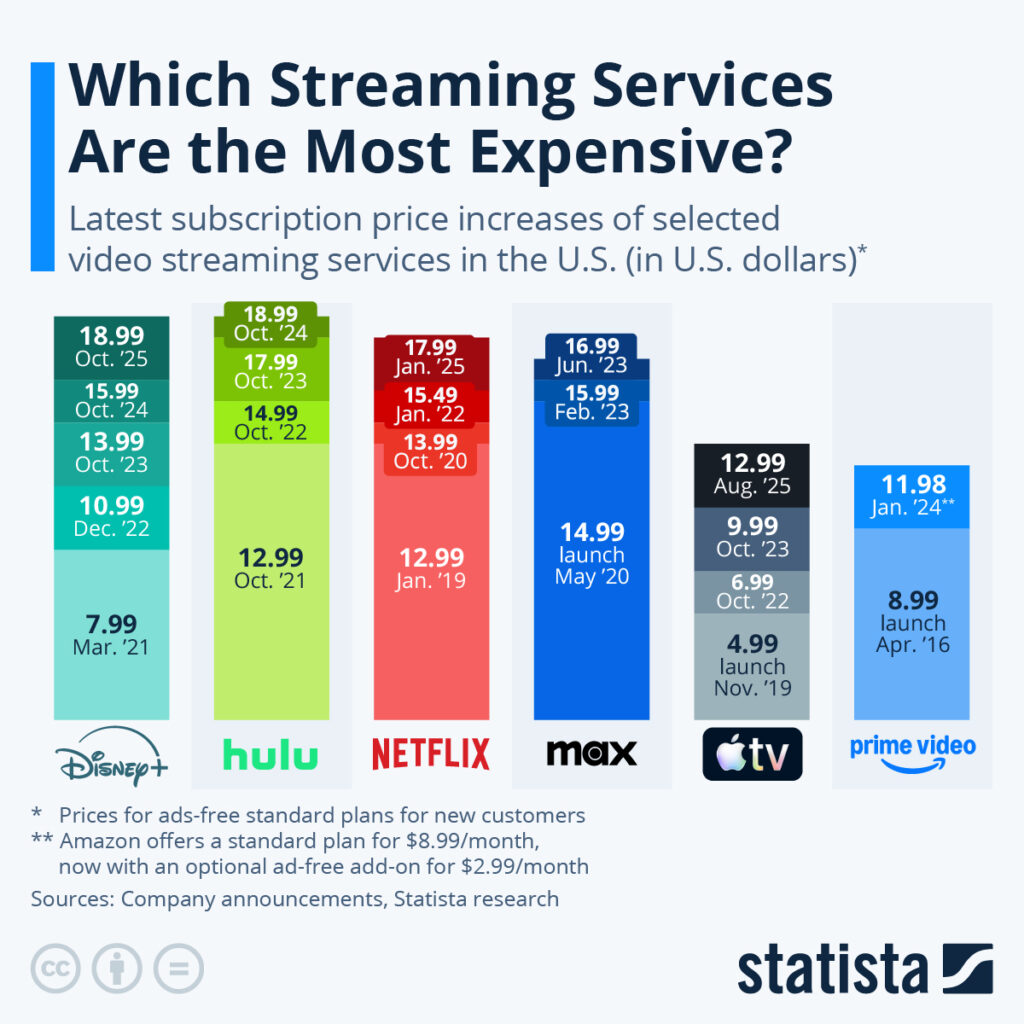
Streaming was once marketed as a cheaper alternative to cable. But the latest pricing data shows a clear shift: most major streaming platforms have raised prices steadily over the past few years—and some are now approaching traditional cable costs.
Based on the chart, which tracks ad-free standard plans for new customers, here’s how the biggest names compare.
The Big Picture: Prices Keep Going Up
Across the board, nearly every major service has increased prices multiple times since launch. What started as $5–$8 subscriptions are now pushing $18–$19 per month.
The most noticeable trend:
👉 Premium positioning is replacing “cheap streaming.”
Disney+: From Budget Favorite to Premium Tier
Disney+ launched in 2019 at a very aggressive $7.99/month. Since then, prices have climbed almost every year:
-
$10.99 (Dec 2022)
-
$13.99 (Oct 2023)
-
$15.99 (Oct 2024)
-
$18.99 (Oct 2025)
User takeaway:
Disney+ is no longer a budget service. Its pricing now reflects its franchise-heavy value (Marvel, Star Wars, Pixar), not affordability.
Hulu: Steady Increases, Premium Positioning
Hulu shows one of the clearest examples of consistent price inflation:
-
$12.99 (Oct 2021)
-
$14.99 (Oct 2022)
-
$17.99 (Oct 2023)
-
$18.99 (Oct 2024)
Hulu’s strategy is clear: position itself as a premium TV-first platform, especially when bundled with Disney+ and ESPN+.
User takeaway:
Hulu is expensive—but still attractive if you rely heavily on current TV shows and bundles.
Netflix: Expensive, but (Still) the Market Leader
Netflix remains the benchmark—and one of the most expensive standalone services:
-
$12.99 (2019)
-
$13.99 (2020)
-
$15.49 (2022)
-
$17.99 (Jan 2025)
Netflix doesn’t compete on price. It competes on content volume, global originals, and brand dominance.
User takeaway:
Netflix is expensive, but many users keep it as their “main” service due to sheer variety.
Max (formerly HBO Max): Premium from Day One
Max launched at $14.99 and climbed quickly:
-
$15.99 (Feb 2023)
-
$16.99 (Jun 2023)
Max hasn’t raised prices as often as others—but it started high.
User takeaway:
Max is priced like a premium cable channel because that’s exactly what it is: HBO content plus Warner Bros. movies.
Apple TV+: Still Mid-Range, Slowly Rising
Apple TV+ remains relatively affordable, but increases are noticeable:
-
$4.99 (2019 launch)
-
$6.99 (Oct 2022)
-
$9.99 (Oct 2023)
-
$12.99 (Aug 2025)
Apple’s strategy focuses on quality over quantity, not a massive catalog.
User takeaway:
Still fair value if you care about premium originals—but less appealing as a sole streaming service.
Amazon Prime Video: The Pricing Wildcard
Prime Video is different from the rest:
-
$8.99/month standalone
-
Included with Amazon Prime
-
Optional $2.99/month ad-free add-on (as of 2024)
User takeaway:
Prime Video feels cheaper, but only because it’s bundled. Once you factor in add-ons, the real cost rises quietly.
So… Which Streaming Services Are the Most Expensive?
As of the latest data:
Most expensive tier:
-
Disney+
-
Hulu
Still premium but slightly cheaper:
-
Netflix
-
Max
Mid-range:
-
Apple TV+
Most flexible pricing:
-
Amazon Prime Video
What This Means for Viewers
The data confirms one thing:
📈 Streaming is no longer cheap—it’s modular.
Instead of subscribing to everything, users are now:
-
Rotating services month-to-month
-
Keeping 1 “core” platform
-
Adding others temporarily for specific shows or events
Final Thought
Streaming services are no longer racing to be the cheapest—they’re racing to be the most indispensable. Price increases are the cost of exclusivity, original content, and brand power.
For viewers, the smart move isn’t asking “Which service is cheapest?”
It’s asking: “Which one do I actually use enough to justify the price?”
More Guides You May Like
- How to Watch Live TV Without Cable in the USA (2026 Complete Guide)
- What Do You Need to Watch Live TV Online? A Practical Guide for US Viewers
- The Best Streaming Services in the U.S – Right Now (2026 Review)
- Best Family Blockbuster Movies to Watch on Live TV (2026 Guide)
- Hulu Live TV vs YouTube TV: Which Live TV Streaming Service Is Actually Better?